

They say kids don’t wanna dance anymore.
Miley doesn’t buy it. Neither does Madonna. And ever since “Bass Persuades” dropped last Thursday, neither do I. I just bought two tickets to see Miley at the Hollywood Bowl.
Not ironically, either. I’m a 47-year-old gay man. The memes and the gaggle delivered the video to me within the hour. It’s the first single off her tenth album, so I did what any serious gay man does: added it to my liked songs and went for a run with it on repeat.
The track is a genius mash-up of everything that is, and ever has been, right about pop music. Over the top, but the right kind of over the top. The video doubles down: it opens in an underground poker game and it’s stacked with references to all the greats, one after another, until you realize the whole thing is just… Miley. And then you want more.
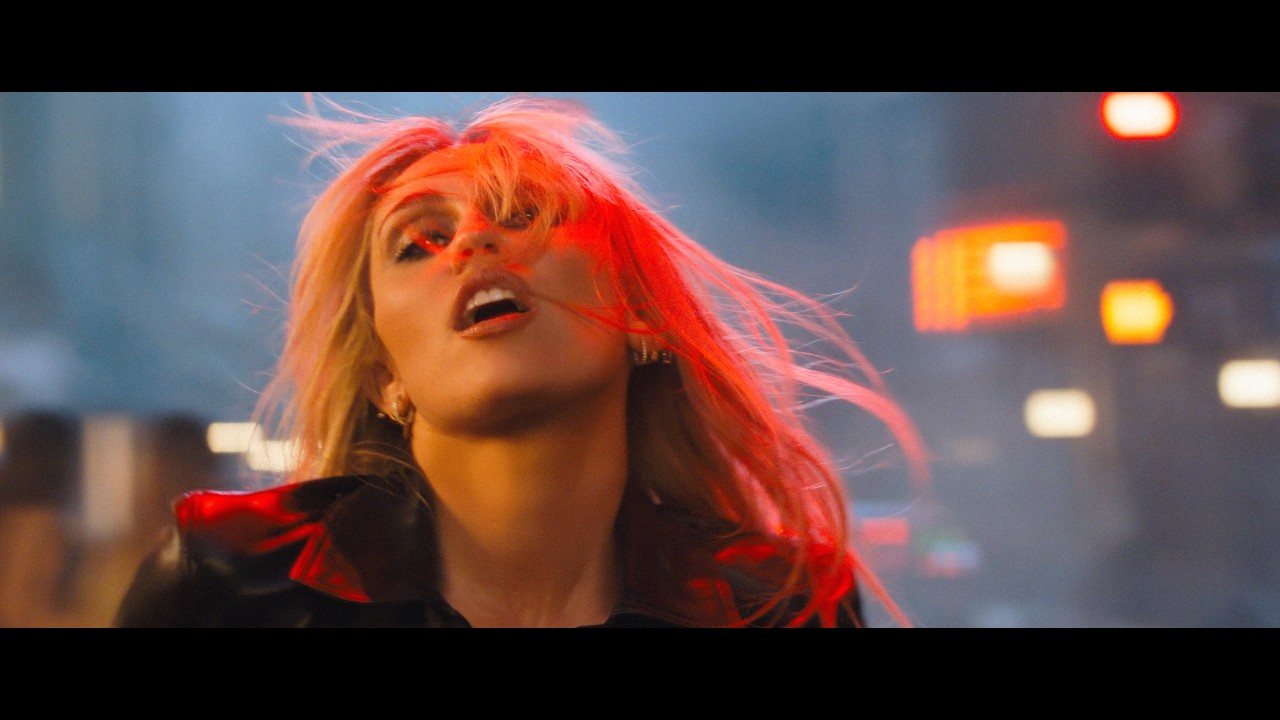
And Miley delivers. But this isn’t a music video review. Stay with me.
Underneath all that spectacle, the song is making a more provocative argument. It starts with the premise that kids don’t want to dance anymore, but Miley never really buys it. “This can’t last forever” is the turn. From there, the answer to distance is proximity: surrender, bodies close together, dance. She isn’t diagnosing a generation anymore. She’s pulling people toward each other. By the end she isn’t asking if people want to dance. She’s daring them not to. And the video matches her: an explosion of pure pop joy, a line dance, bodies contorting, choreography built to be watched with other people. Mert Alas directs the hell out of it. Styling, choreography, casting: every frame is at full volume.
For a few minutes, pop feels communal again. Like somebody remembered what all of this was supposed to feel like.
Somewhere around the second chorus I realized she was talking directly to me: put the phone down. Remember joy. Get up. This can’t last forever. And then my brain did a funny thing: hadn’t one of my other Mothers put almost the exact same message in my head eight weeks earlier? That line isn’t a shrug. It’s a bet.
And here’s where the timing gets insane. Put “Bass Persuades” next to the “One Step Away” sequence in Madonna’s Confessions II film and you’re watching the same film in two dialects. Both start in a hidden room: Madonna moving through a stark, private interior, Miley crashing an underground poker den staged in pure Tom of Finland, leather caps, muscle, menace, gay iconography quoted without a footnote. Both women end up crawling across a table in black, frames so similar you’d swear they shared a storyboard, both echoing Madonna of the Truth or Dare era. Same summer. Same damn dance.
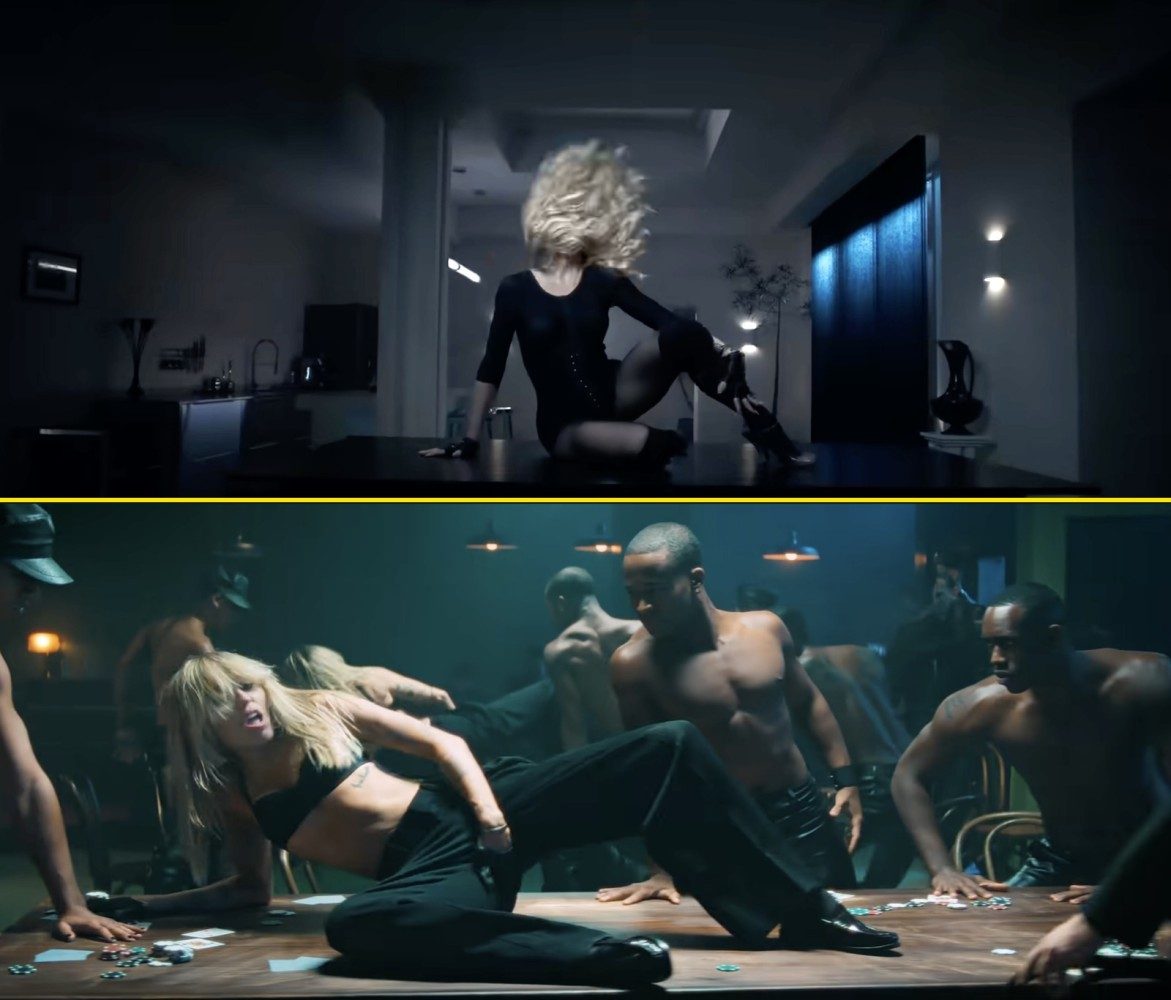
Then the films diverge, and both women go feral about it. Madonna returns to the club, the room she has always owned, and lets it come apart from the inside: bodies sweating, colliding, surrendering until the room feels possessed. Miley goes further. She blows the doors open and takes it to the street, a possessed dance leader beckoning the moon, pure Thriller logic: dance as contagion. What starts as “kids don’t want to dance” ends with an entire block catching it. She isn’t asking anymore; she’s transmitting. Madonna makes the club go feral. Miley makes the street catch fire.
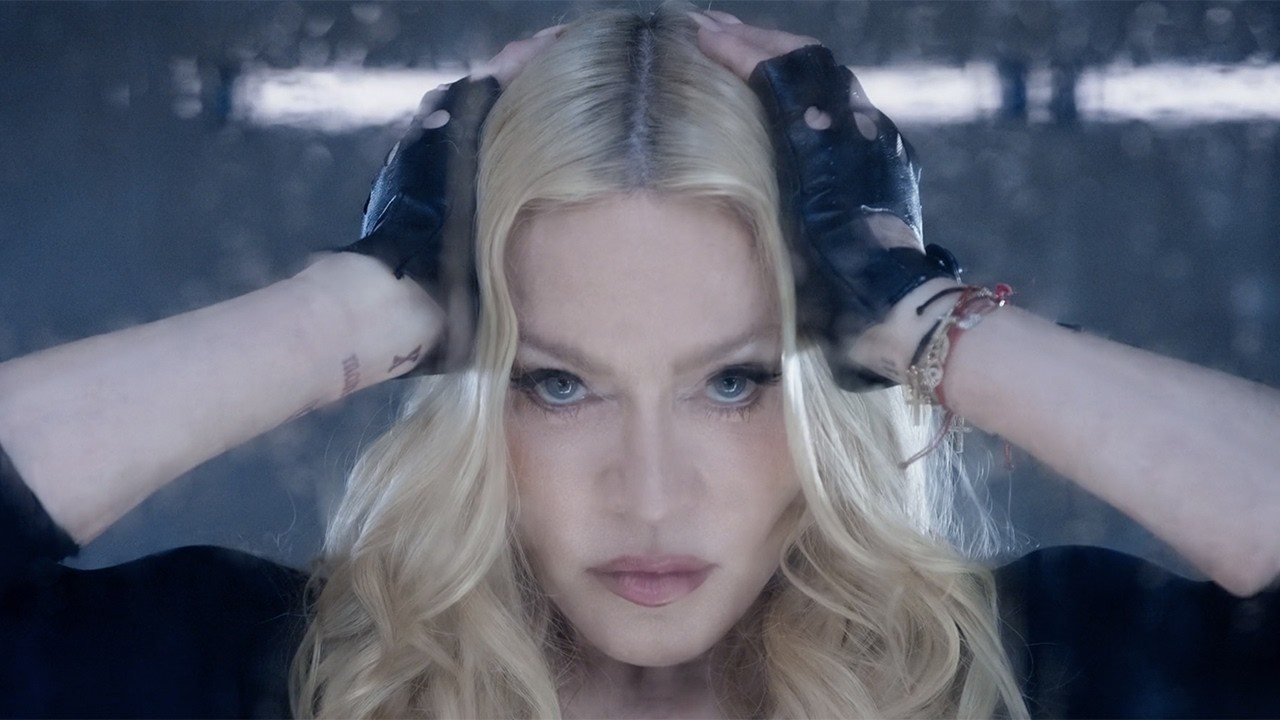
And Madonna had already put almost the same invitation into the world two months earlier: everybody get up and dance; the crowd itself becomes the work of art. Confessions II, her first album in seven years, is built with Stuart Price as one continuous dance mix, the way albums used to work. On “I Feel So Free,” the dance floor is safety in numbers: the place where she can disappear into a crowd, drop the fame, and become whoever she wants. On “One Step Away,” she says the quiet part loud: dance music isn’t superficial; the floor is a threshold, a “ritualistic space.” “Danceteria” is a love letter to the New York club that made her. The record is full of grief, memory and reinvention. Her answer, at 67, was to build a dance floor and open the door.
And she didn’t stop at the album. She and Price took it to actual clubs with Club Confessions nights, partnered with Grindr, took over the grid, and turned Times Square into a Pride dance floor with a surprise pop-up livestreamed inside the app. She didn’t just sing about the dance floor. She built the room, over and over, and let brands help her do it. Madonna has already shown us what her dance floor looks like. Miley’s album hasn’t even dropped yet. She’s only sent the first invitation, which makes what comes next even more exciting: seeing how she turns “Bass Persuades” into a whole era, and how she brings her dance floor to the world.
Two of the biggest icons in music. Two generations apart. Same summer. Same damn dance. Same message: get up and dance.
And before anyone shrugs, of course pop albums have dance tracks, that’s the job, look at what they chose to put out front. Madonna literally called “One Step Away” the manifesto. Before the record even arrived, she delivered a short film that didn’t just talk about the dance floor; it created one. Miley comes back the same summer and leads her next era with “Bass Persuades,” in eerily familiar visual language. It’s so clean, fresh and impossibly synchronized you could almost suspect AI had a hand in it. But the thing that matters most is unmistakably real: bodies moving together. And Miley’s video doesn’t pretend otherwise. It leans all the way in, right down to the crotch grab in a halter top, straight off the Truth or Dare stage. That’s not two pop stars happening to make dance music. That’s a cultural conversation happening in public. You can call it coincidence. I call it a signal, and reading signals is literally my job.
Because both of them are responding to the same quiet crisis: we stopped dancing. Gen Z drinks less, parties less, gathers less. Some of that is healthy, honestly. But underneath it, people are lonelier, more isolated, more online, and less likely than generations before them to accidentally end up in a room full of strangers moving to the same song.
The MTV that made a music video feel like a global event is gone. YouTube gives us infinite access; MTV gave us a shared room. One video could land in millions of living rooms, get argued about at school the next morning, and become culture before we’d decided whether we liked it. We traded a shared room for infinite access. Better in a lot of ways. Lonelier in others.
Maybe that’s why “Bass Persuades” hits so hard. It feels built for the event-video era, Britney, Michael, Madonna, Gaga, except the global room that once gathered everybody around it is gone. Now the video has to find us one algorithm at a time.
And the desire clearly isn’t gone. Live music is booming. People still cross cities, pay absurd ticket prices, stand shoulder to shoulder with strangers and scream the same words at the same time. We haven’t stopped wanting collective experiences. We’ve just lost some of the default places that used to deliver them.
So we’re inventing new ones. Warehouse parties. Sober raves. Morning dance floors where my friends with kids show up at 7 a.m., dance for two hours and still make school drop-off. Pop-ups. Street takeovers. Temporary rooms that exist because somebody gave people a reason to gather. The behavior didn’t disappear. The room changed. And that’s the signal.
Some women become more than stars. They become Mothers. Madonna. Cher. Beyoncé. Kylie. Britney. And now, Miley.
Miley’s arc makes it sweeter. We’ve watched the metamorphosis in real time: Disney’s Hannah Montana to Miley Cyrus, child star to center stage, wrecking ball to Grammy winner. In 2013, the same pop machine that celebrated Madonna for being provocative was horrified when the girl it still saw as Hannah Montana walked onstage as a grown woman named Miley Cyrus. A decade later, the tables have fully turned: “Flowers” won her Grammys, she’s on top of the charts, and the MTV that once made a music video feel like a cultural event is effectively gone; Miley even calls out its absence in the lyrics. She’s reborn: two names shed, first the character, then the surname, one word now, like the greats she can call contemporaries. Even the auto-tune on “Bass Persuades” is a flex, not a crutch: she has one of the best voices in modern music, so she’s free to make a vibe instead of proving a point.
She’s also been open about not wanting kids. I opened the comments on a post about it, and the first one stopped me cold:
“She already raised a generation.”
And they’re right: an entire generation was raised by Hannah Montana. Her godmother Dolly never had kids either. Raised generations anyway. Maybe that’s the family business.
And just days after we lost Dolly, her goddaughter steps back into the spotlight with a cultural shift even the best marketers aren’t ready for. You don’t need a research deck for this one. When two of the biggest icons, Mothers of the whole damn planet, are saying the same thing, doing the same damn dance, and handing you the soundtrack?
You fucking listen!
Culture can’t be interrupted. It has to be experienced. And right now it’s moving back to the dance floor. Madonna and Miley aren’t starting the shift; they’re announcing it. What’s missing isn’t the desire. It’s the room. A song can build a spiritual dance floor. A brand can build the room around it: the floor, the sound, the reason to show up, the thing you text your friends about after. That’s not a media buy. That’s a brand experience.
I’ve built my whole company on one belief: the best brand experiences don’t interrupt culture; they find an authentic way into it and make it real. Somebody still has to build the room. The brands that do will own something no impression ever bought: a memory made with other people. That’s where brand love actually comes from.
I build rooms and brand experiences for a living, so sure, I’m biased.
But I’m also holding two tickets to the Bowl, and Mother is always right. This can’t last forever.
I’m ready to dance.
Jason Bitensky is the Founder & CEO of YW3, a Brand Experience Studio. Culture, Realized is his quarterly read on the signals he can’t stop obsessing over.
Notes
- First published on LinkedIn as Culture, Realized. Issue 01, September 8, 2026.
- Videos are the official MILEY and Madonna releases on YouTube and play muted from YouTube as you reach them. The Times Square clip embedded in the LinkedIn edition is no longer available on YouTube and is not reproduced here.