
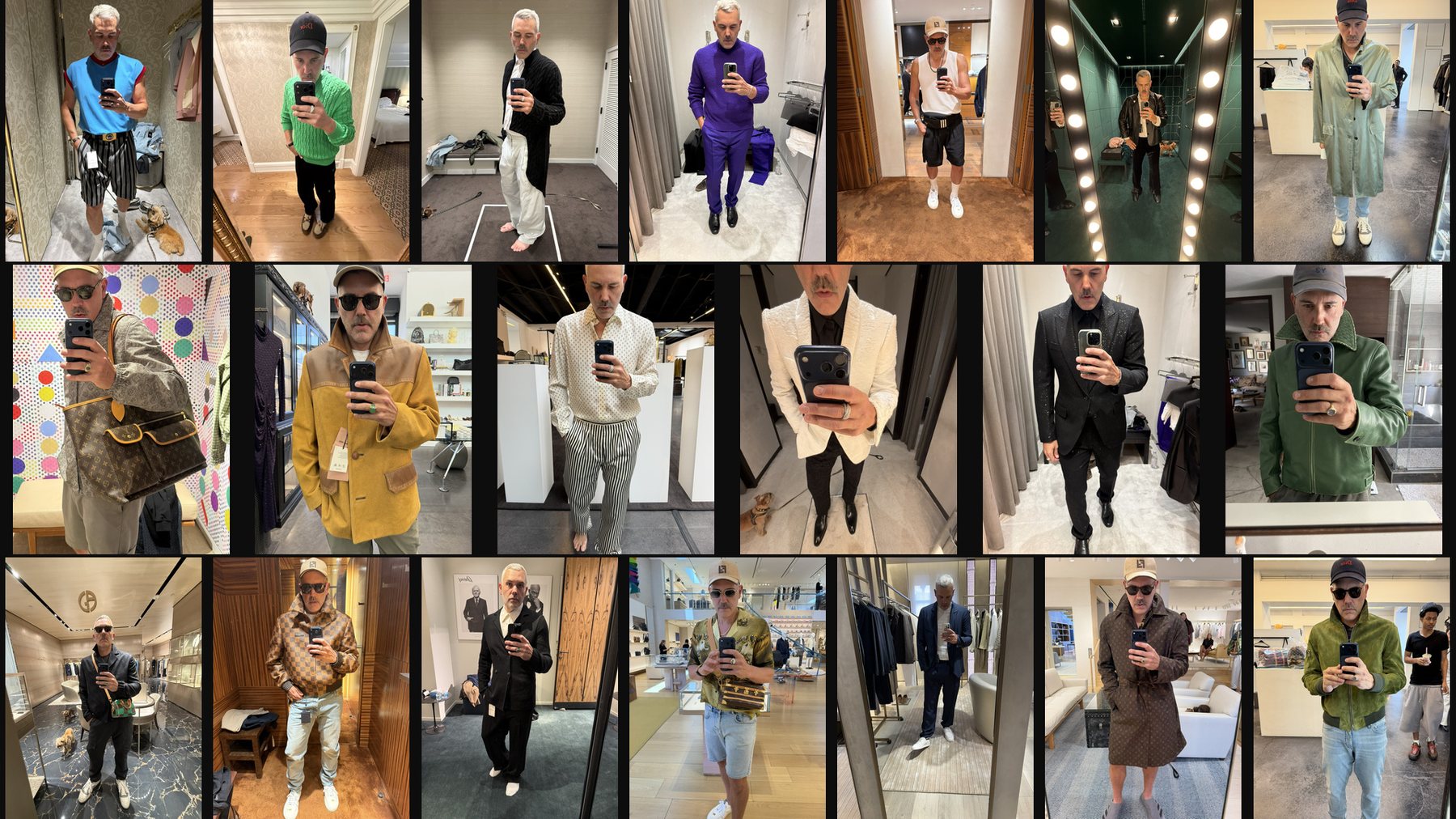
Buckle up, people. We’re going down a luxury wormhole.
I’m opening the vault: the grails, the receipts, the ridiculous deals, the fakes, and the decisions that seemed entirely reasonable at one in the morning. Fair warning: I am a luxury shopper of the committed kind, and if a four-figure T-shirt makes you queasy this does not get easier. Consider yourself warned.
One December evening in SoHo. Twenty-five degrees, five o’clock, and the sun is already gone. I’ve lived in Los Angeles long enough that a New York winter now feels like a decision somebody else made for me. I’m on Greene Street walking past the luxury boutiques. A few shoppers here, a few there. The point is, it’s prime shopping season, people. Then I turn the corner and there’s a line out the door.
The RealReal.
A dozen or more people, twenty-somethings to boomers, freezing their a*ses off to buy somebody else’s luxury goods. Nobody looks troubled that the merchandise has already had a life. Quite the opposite. That’s the appeal.
Everybody says luxury retail is in crisis. On this block, that evening, the line was at the resale shop. People still want beautiful things. They have other places to find them, and other ideas about what to pay.
Luxury didn’t lose the customer. It lost the plot. The plot is standing outside in 25-degree weather, in line at someone else’s store.
McKinsey estimates that price increases accounted for more than 80 percent of personal luxury goods growth from 2019 to 2023. More expensive did a lot more work than more pieces. Bain estimates the customer base shrank by about 50 million between 2022 and 2024. Those aren’t fifty million people who suddenly stopped having taste. Some couldn’t afford the next increase. Some stopped seeing the point.
Price increases drove the growth
McKinsey, 2019 to 2023
Fewer luxury customers
Bain & Company, 2022 to 2024
Meanwhile, The RealReal reported $642 million in gross merchandise value in the third quarter of 2026, up 23 percent. Goods changing hands, not the company’s revenue. Its CEO talks about helping people discover what to buy, keep track of what they own, and decide when to sell. Psst. Luxury CMOs. Yoo-hoo. Over here. Are you paying attention? That’s a relationship that can last longer than the first purchase. A jacket can have five owners. Which of them does the house know?
I’m probably your best customer. You’ve never met me.
Also: should I get in line at The RealReal?
I did. And I bought the stock. That’s a disclosure, not a recommendation. Apparently shopping wasn’t enough.
Chapter I
THE $500 SWEATSHIRT.
IN THE EIGHTIES.
The condition is hereditary.
My mother, Donna Jessica Bitensky, sold $500 sweatshirts in the late eighties. Five. Hundred. Dollars. For a sweatshirt. Roughly $1,300 in today’s money. And they sold. Sold out, actually. Lines around the block.
She started with Dumplin’s, luxury children’s clothing, then Bouche, then Donna Jessica, her bohemian women’s and resort label at Neiman Marcus, Nordstrom and the independents. She called it wearable art and she meant it. Patchwork, strange textures, intricate new details you discover every time you look at the garment. She was making and selling pieces one at a time, by hand in the U.S., using repurposed fabrics long before anyone called it upcycling. Clothes with no interest in looking like anything else on the rack.
And this was the early ’90s, when the country was struggling through a recession. My mother’s booth at the Javits Center looked like nobody else’s. Custom wall enclosures, table covers, seat covers, right down to the notepads and order sheets. She didn’t just design the clothes. She designed the world you walked into to buy them.
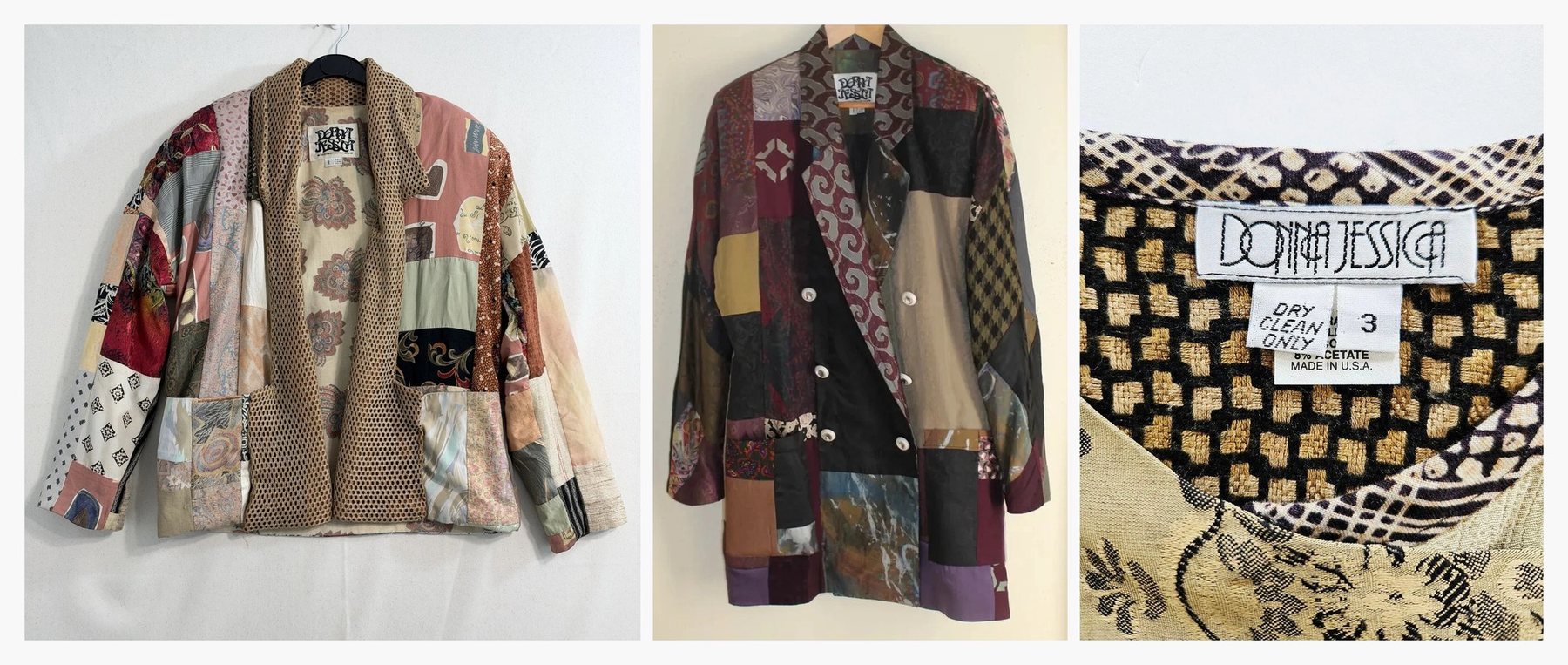
When she couldn’t afford silk by the yard, she bought men’s silk ties in Chinatown. I cut them open on the factory floor so she could use the fabric. I also worked her booth at the Javits Center, because I was free labor. I learned what it takes to make something beautiful. And I watched her make the people who bought her wearable art feel like they belonged to the world she’d created.
Now John Galliano is working with Zara, taking its past seasons apart and making something new out of them. Re{form}, the first collection in their two-year partnership, launched in October. Galliano. At Zara. My mother had a kid with scissors and a pile of ties. Different scale, obviously. But I recognize the impulse. Look at what’s already here. See what else it could become.
People flew in to shop with her. She worked her own boutiques during normal business hours and her sample sales. Spend $99 or $2,000, you met the designer, you heard the story, you talked to the woman who made it. Access to the artist wasn’t a spending tier.
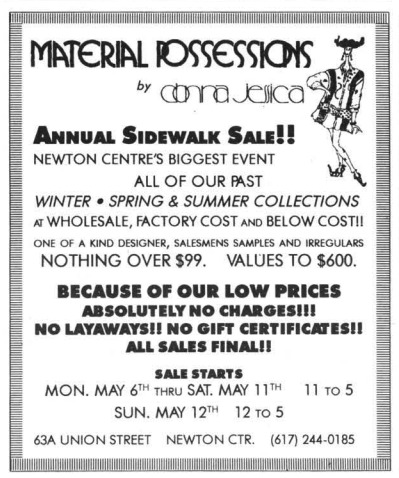
Her annual sample sales were legendary. Newton Centre, 1996. My mother’s Material Possessions by Donna Jessica annual sidewalk sale. Pieces valued up to $600. Nothing over $99.
The prices got people through the door. My mother made them come back.
And yes, I worked the sale. My hourly rate was, naturally, $0.
My father wasn’t an extravagant man. He let my mother dress him for the part. But he had a weakness for beautiful cars. Porsche, specifically. (Two syllables, please. We’re not animals.) Working two jobs while she built the business, with barely enough for the mortgage, he drove a 928. The Risky Business car. Sensible? No. Even then, I understood it.
It was his only Porsche for decades. Last year, at 77, he bought himself a used Panamera. Nearly half a century of loving the brand, neither car bought from a Porsche dealer. Would anyone there have known what those cars meant to him? They never knew his name, or that he’d passed the obsession on to his son.
Me at 34. I’d just closed the biggest deal of my career and wanted to mark it. A friend had told me about the deal Porsche gave him on the new 991.1. Over Thanksgiving weekend, I walked into Porsche Beverly Hills and drove home in a white 911. An absurd reward, and one I had worked very hard to be able to give myself. There have been a few since. Seven, if you’re counting, plus a Macan Turbo after I blew out my knee skiing and couldn’t get in and out of the 911. My first novel opens in a Porsche dealership. The obsession has escaped into fiction. Eleven years and eight Porsches later, my father’s last name is in their customer database. But still to this day, nobody at Porsche has ever asked me where the obsession began.

One parent showed me how beautiful things get made, and how a person builds a community around them. The other showed me that wanting something can last a lifetime, even when life circumstances separate you from your objects of desire for more than fifty years. My grandmother taught me the third thing: beautiful objects are what you give to the people you love.
Nature? Nurture? Both, apparently.
Chapter II
EVERYBODY’S A DEALER NOW
For years I said I’d never sell anything. Watches, jewelry, handbags: still no plans. But the clothes are different. Wearable art. My mother made it to go out into the world; apparently I want some of mine to go back out there too.
Today I have three resale storefronts (hello, @HunkandTwunk), a concerning number of saved searches, and an archive that will someday raise questions for my heirs. Some things I list at a price I can’t imagine anyone paying. Then again, maybe someone will. I get to decide what it would take for me to let them go. They get to decide whether I’m out of my mind.
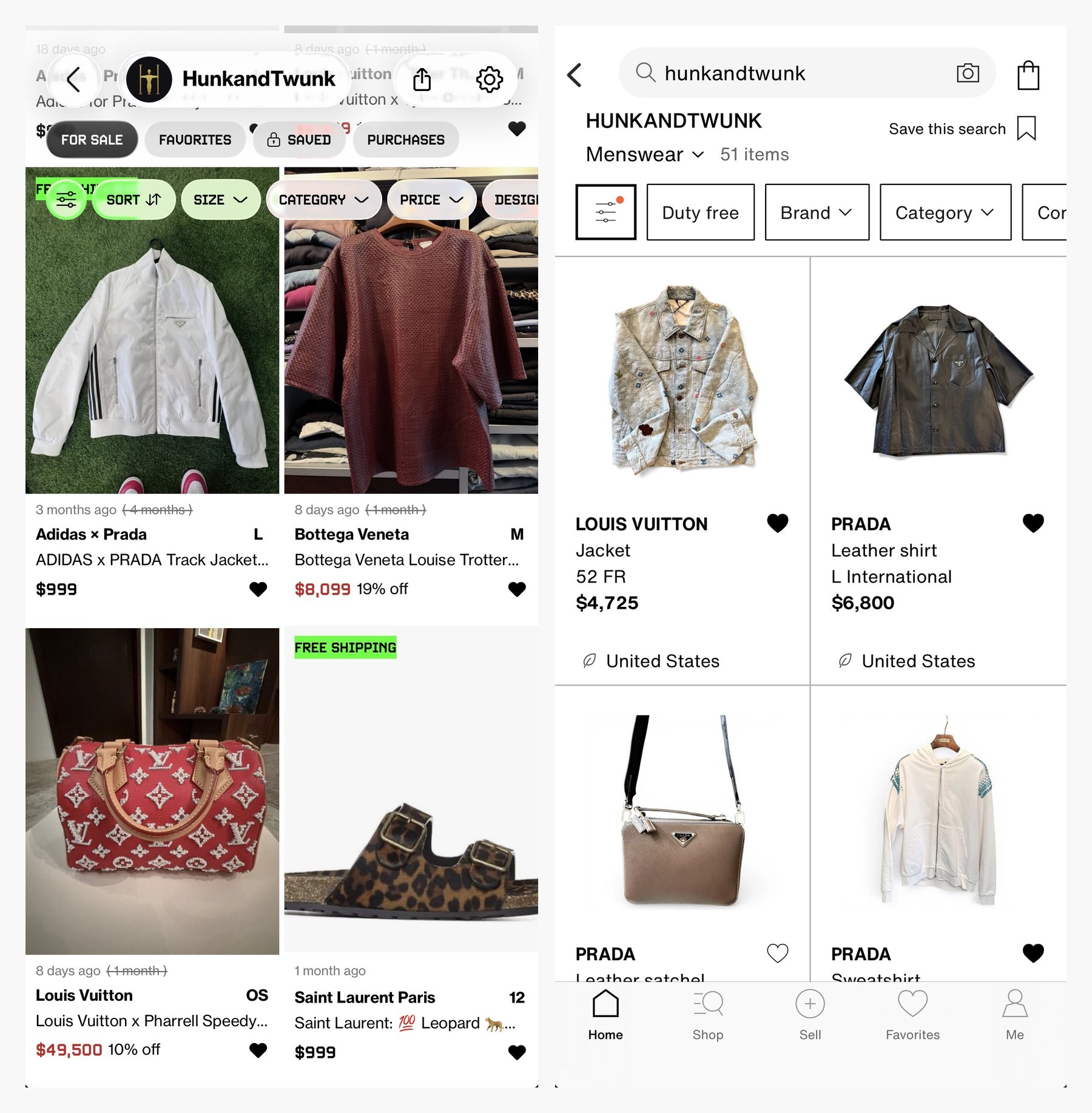
I hunt in vintage stores. I inspect the obscure rack. I ask what’s in the back. Then I go home and do it all again across eBay, Vestiaire, The RealReal, Grailed, 1stDibs, and Chrono24. The same jacket under four URLs, in three currencies, on two continents. That’s Tuesday.
My closest girlfriend, Erika, and I share what we believe is a peculiar habit. When we shop online, we sort by price, HIGH to LOW. She says we’re the minority. I say it’s obvious. All the good stuff’s at the top. Duh.
Or is it? Somewhere in the writing of this piece I started to think she’s right. If the luxury brands don’t give us a better reason to start at the top, we’re all heading to low-to-high.
You don’t need my banter to see how complicated luxury shopping has become. But after the examples I’m about to show you, your next hunt might look very different.
We have access to almost everything, everywhere, at prices that can make absolutely no sense. Until you start asking questions.
Current season or archive? Worn or unworn? Original or reissue? Same size, same condition, same country? Does the price include getting it to your door?
And is the damn thing even real?
Galliano at Zara is one way in. One of fashion’s most sought-after living designers, bringing his extraordinary creative vision to a more affordable’ish price point. A new collection from a luxury house is another. So is an original archival piece that’s spent twenty years waiting for someone to recognize its magic again.
More access? Absolutely. More choices than ever? Without question.
A straightforward shopping decision? Good luck.
Kim Kardashian wore Tom Ford-era Gucci leather and fur in Aspen at the start of 2026 (MAJOR Grail Alert!!). Then, in September, her new partnership with Law Roach put her in a Tom Ford-designed Yves Saint Laurent gown from fall 2004. Different house, same designer, another archive suddenly in front of millions of people. At Gucci, Demna has been mining the Tom Ford years for a new generation. Haider Ackermann is making his own vision at TOM FORD, the label. And Law Roach? He puts the actual Tom Ford archive back on a red carpet. New Gucci. New TOM FORD. Original Tom Ford. Tom Ford YSL. Pick your rabbit hole.
Which brings me to a 1999 Tom Ford-era leopard fur Gucci coat I’ve been watching on eBay. Asking $8,250, with a make-an-offer button. At the time of publishing, 93 likes and five shopping carts, but no sale. And the listing says almost nothing: “Runway and ad campaign. Excellent condition no flaws.” Not a word about provenance, the Tom Ford Gucci revival, or Kim in Aspen. Now put that coat in front of the right stylist, the right collector, the right audience. Could Law Roach or a dealer like 4Gseller make somebody look at it and think $25,000? $50,000? More?
I’m asking. I don’t have a buyer at either number. But the coat doesn’t have to change for people to see its value differently. Someone recognizes the collection, finds the runway image, puts it on the right person. The next obsessive may be looking at the same listing I am, wondering whether to make an offer, wear it, resell it, or keep it until the moment comes around again.
That’s why provenance matters. It doesn’t tell me what the eBay coat is worth. But it tells me why the story attached to it matters.
My bet? Better than you might think. I have receipts.
In April 2025, I bought a Tom Ford-era Gucci denim jacket with a fur collar for $875. Had it dry-cleaned, hung it in my closet, and never wore the damn thing. Seventeen months later, I sold it on Grailed for $1,175. That’s 34 percent more than I paid, before fees and dry cleaning.
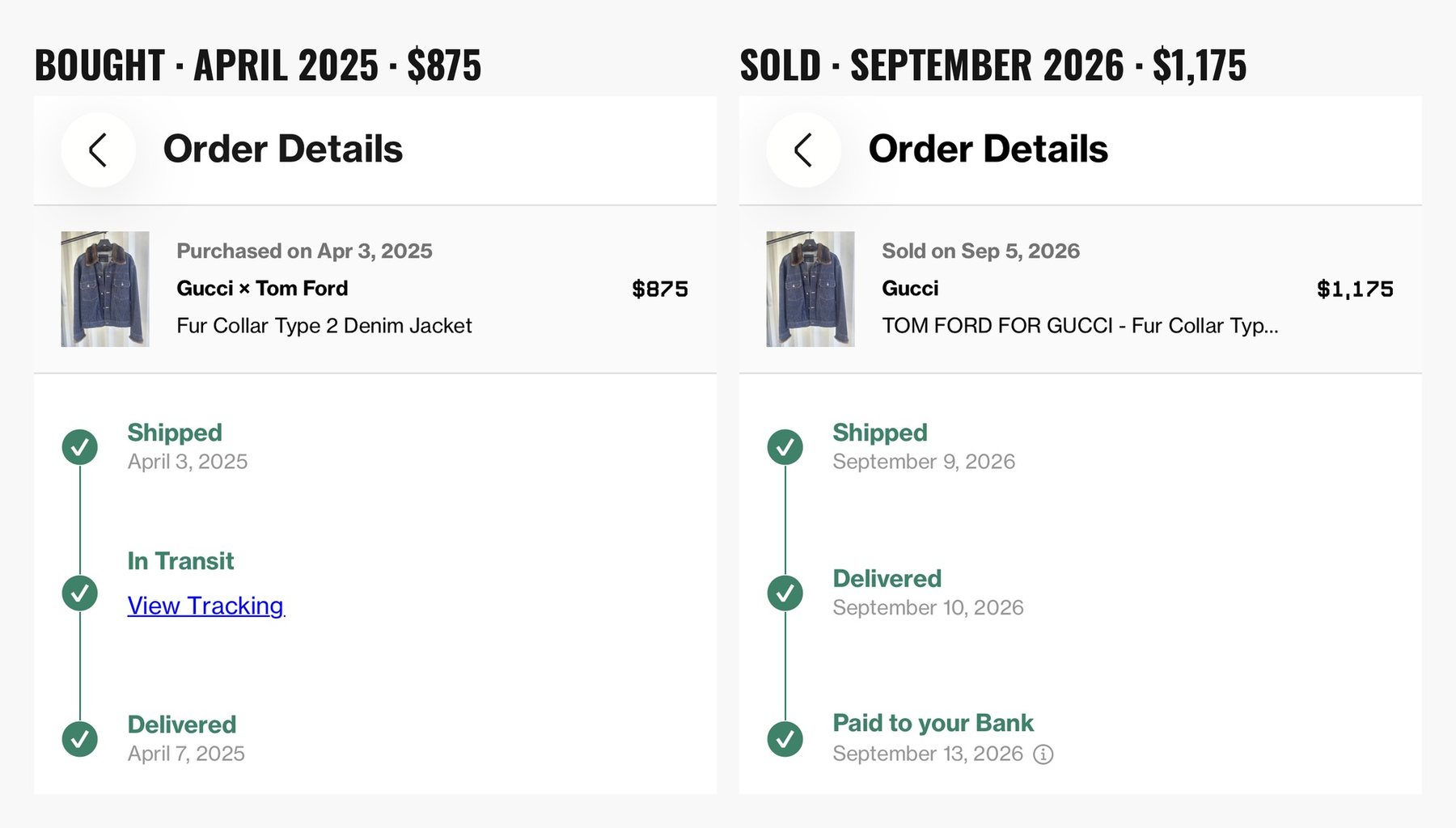
Lucky? Maybe. Did the renewed obsession with Tom Ford’s Gucci years help? Also maybe. I can’t prove what moved the price. But I bought a piece of fashion history, did absolutely nothing with it, and someone else paid more to make it theirs.
And then there are the auctions. Where things get really interesting.
In March 2026, Kerry Taylor offered pieces from Lee Alexander McQueen’s own wardrobe. His white spring 2003 Gucci suit by Tom Ford, sold with his shoes, has a published result of £41,600. He wore it to collect his CFDA award and again on his own runway. That’s a particular man’s life in a particular suit.
And in September, a custom McQueen Plato’s Atlantis Armadillo ensemble from Naomi Campbell’s personal collection, including those extraordinary shoes, sold at Fair Warning for $1.586 million.
Nearly $1.6 million. For an outfit.
Two extraordinary objects. Two very different histories. And two auction results that remind us just how powerful provenance can become.
Does any of this mean that $8,250 Gucci coat is worth $50,000? Of course not. But it does mean that the original price, the current asking price and what the next obsessive might eventually pay are three entirely different things.
And somewhere in that gap, collectors, dealers, stylists and culture itself are helping determine what these objects are worth.
I’m part fashion archivist, part historian, part detective, part trader, part romantic. One hundred percent modern treasure hunter. Some things hold value. Some appreciate. Some lose half the moment you put them on. An asking price is a proposal. A sale tells you somebody agreed and can be the beginning of a market. What the seller keeps after fees depends on the platform.
I’ve found a Miu Miu sweatshirt on eBay for $300 while The RealReal was asking $1,800 for what appeared to be the same one. I’ve also bought fakes that fooled me completely. A convincing listing is still a listing. The hunt doesn’t exempt me from being wrong.
Which brings us to the asset-class debate, and I’ll be the one to say it: most of it is Birkin-outperforms-the-market propaganda. The endlessly repeated Baghunter study claimed average annual appreciation of 14.2 percent from 1980 to 2015, ahead of stocks and gold. A handbag reseller published it. That headline is not what an ordinary owner necessarily gets after buying, insuring, storing and selling a bag. Then, in July 2025, Jane Birkin’s own original sold at Sotheby’s in Paris for $10.1 million, including fees, and the propaganda had a very good week. Jane’s bag is an extremely rare case, but record prices for archival pieces are getting less rare. Some of these objects are assets. Most of them are objects. I lead with love for the piece, but I also do the economic homework. And if I decide to sell, I get to help tell its next story, maybe even make some money along the way.
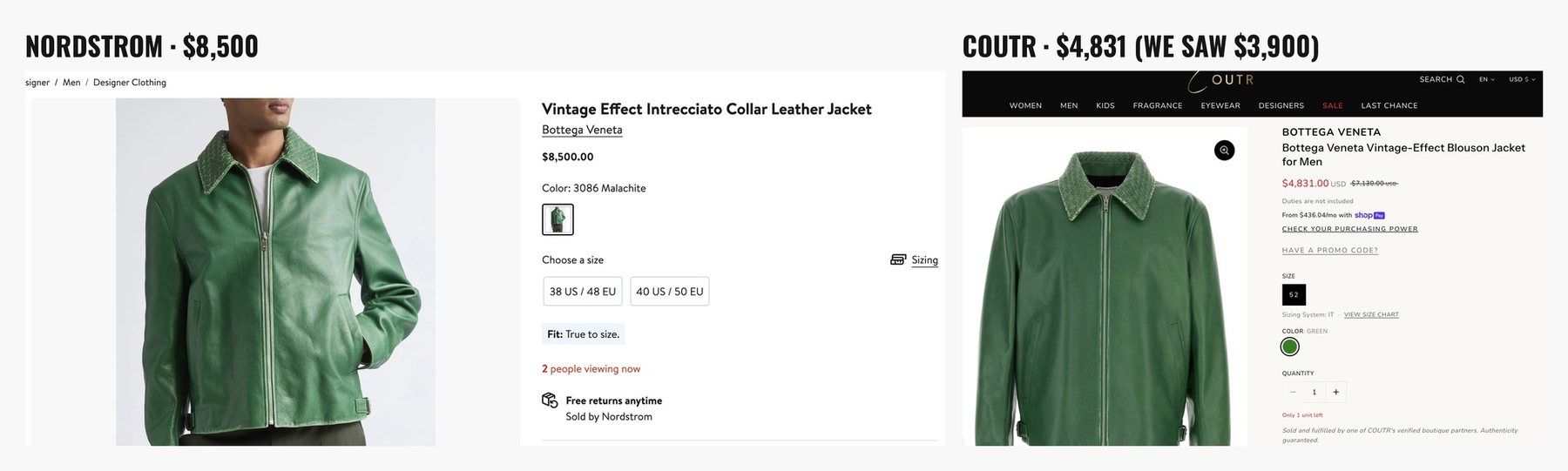
Even the price of something new needs unpacking. I was tracking a deep-green Bottega leather jacket with an Intrecciato collar. Nordstrom had it at $8,500. Coutr showed me a promotional quote around $3,900 before duties, taxes and shipping. I never got to checkout, so call it a sighting, not a purchase. By the time I sat down to publish, the promotion was gone and the same jacket was back up to $4,831, marked down from $7,130. Duties still not included. A $4,600 gap, then a $3,700 gap, on my screen, not a verified saving at my door. Currency, regional pricing, inventory, who needs the cash: I now have several prices to investigate before I’ve even tried the jacket on.
Enter a Barolo-colored leather T-shirt.
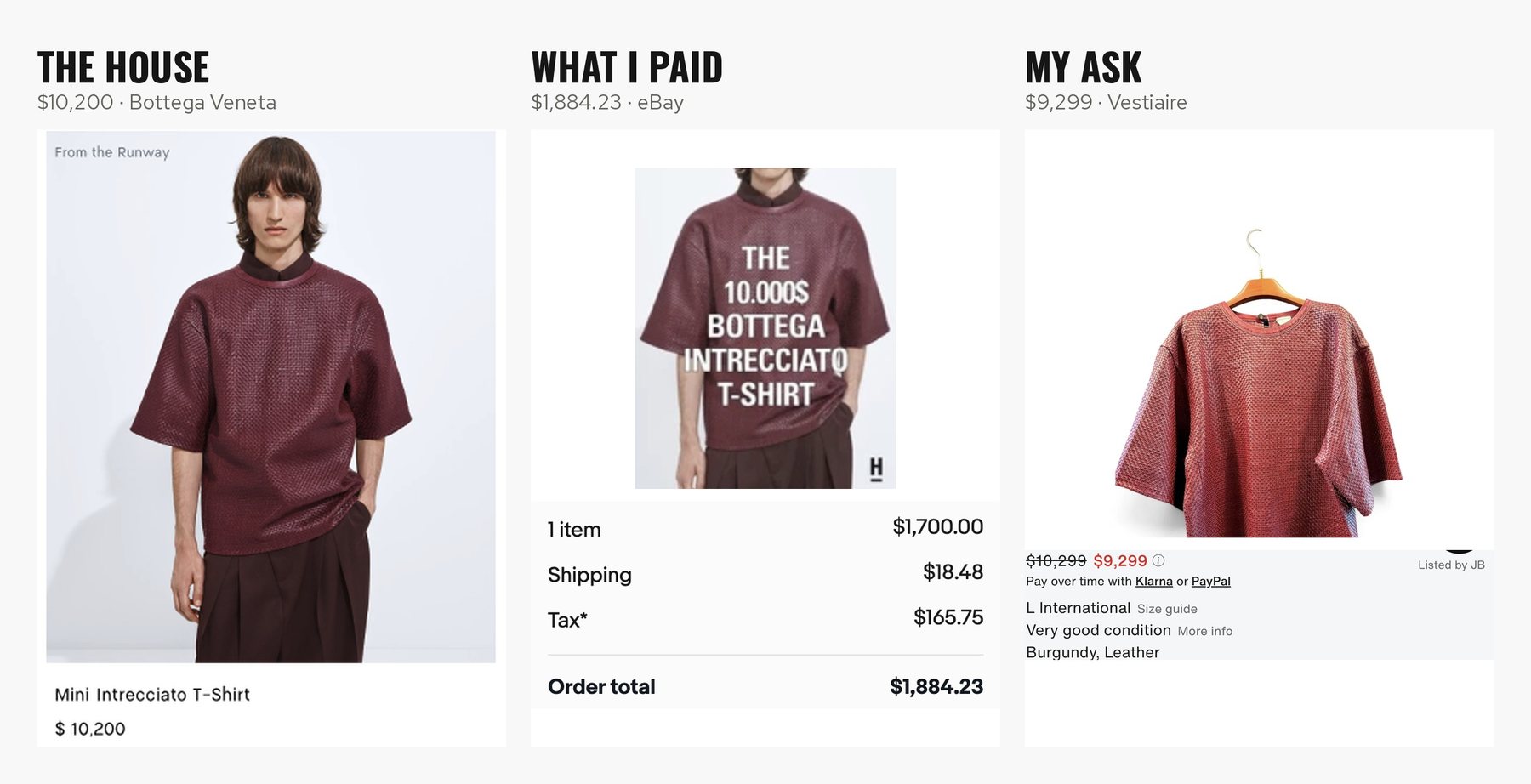
Louise Trotter’s first collection for Bottega Veneta had me transfixed. Mini Intrecciato: leather cut into tiny strips and woven into a shirt. The house’s US price: $10,200. Outrageous? Yes. Craft? Also yes. Naturally, I wanted one. Highsnobiety and GQ noticed it too. I was already hunting high to low “Bottega Men” on eBay.
Then one day, there it was. I watched the eBay seller move the price from $5,000 to $3,000 and back toward $8,000. We negotiated. They took $1,700. With tax and shipping, $1,884.23. For the $10,200 shirt. Yes, please.
And now I’m offering it for sale. The same shirt, worn once, tags still on, is in my Vestiaire and Grailed storefronts. Vestiaire: $9,299, down from $10,299. Grailed: $8,099. That’s an ask, not a sale. I bought something I believed was tremendously undervalued from a seller who needed cash. I have the luxury of waiting for a collector who sees what I see, and will pay a premium. I believe that collector exists. I just don’t know when they’ll arrive. I can also keep it. Vestiaire suggested I drop it to $742.
Thank you, algorithm. I have a few questions about how you got to that calculation.
I don’t know what anyone will pay me. But I can photograph the weave, show the label, explain the collection, and put it in front of someone who might understand why I wanted it. That’s my little storefront. 4Gseller has built a designer and vintage showroom in SoHo. The scale is different, but the opportunity is familiar: make an edit people trust, bring them to it, and see what they’ll pay.
Buying from a stranger online can be efficient and utterly impersonal. Sometimes that’s fine. Show me the piece, answer my questions, pack it properly. Authentication services and buyer protections can help, where the item and transaction qualify; they aren’t a promise that nothing will go wrong. A brand’s record of its own sales won’t capture everything I’ve inherited or bought elsewhere. And in some cases the brands don’t offer services to authenticate archival, vintage, or second hand items at all.
With unprecedented access to new and archival luxury, I still want somewhere to take these beautiful things when they need care or repair. Someone who gets just as excited about a rare piece of the house’s history as they do about something from its latest collection.
The luxury houses have an opportunity here. I’ve walked into three that understood it instinctively.
Chapter III
THE DOOR SWINGS BOTH DIRECTIONS
Brunello Cucinelli. I saw a handsome celebrity on a red carpet in a vintage Brunello tuxedo. A fashion influencer account I follow called out the look. Naturally, I went looking. I found one in my size on eBay, new with tags, for about 85 percent off retail. The only one in the world in my size, authentication offered, free returns. Clearly an omen. So I bought it, negotiating an additional discount along the way.
I brought it to Brunello. They took it out of the garment bag and marveled at its beauty. The team dated it to approximately 2017, making it about nine years old. They set up a dressing room in the back. Coffee, snacks, water and treats for my dogs. Then they spent over an hour hand-fitting the tuxedo to my body, with shoes and accessories pulled from the floor. When it was done, they handed me a ticket. I asked how much. Zero. That’s what happened on my visit. I bought the tuxedo on eBay. Brunello made me feel like I’d bought it at full retail on Rodeo Drive.
Celine. A rare Hedi Slimane Baby Cat leopard coat (Grail alert!!), bought through a reseller, arrived in a cheap plastic bag tossed over my fence, with all the ceremony of garden supplies. I brought it to Celine on Rodeo Drive for repair. They took it out of the bag. The salespeople stopped to admire it, then asked me to put it on in front of the store’s largest mirror. They wanted to see their own history worn by its new owner.
They repaired it without charging me. When I came to collect it, they asked me to model it again. Of course I did. Then they put it onto a beautiful Celine hanger, into a garment bag, and home with me. No one tried to make a sale on either visit. We were just people who loved a beautiful object. They sent it home like a piece of couture I’d purchased from them.
Then there’s Van Cleef & Arpels.
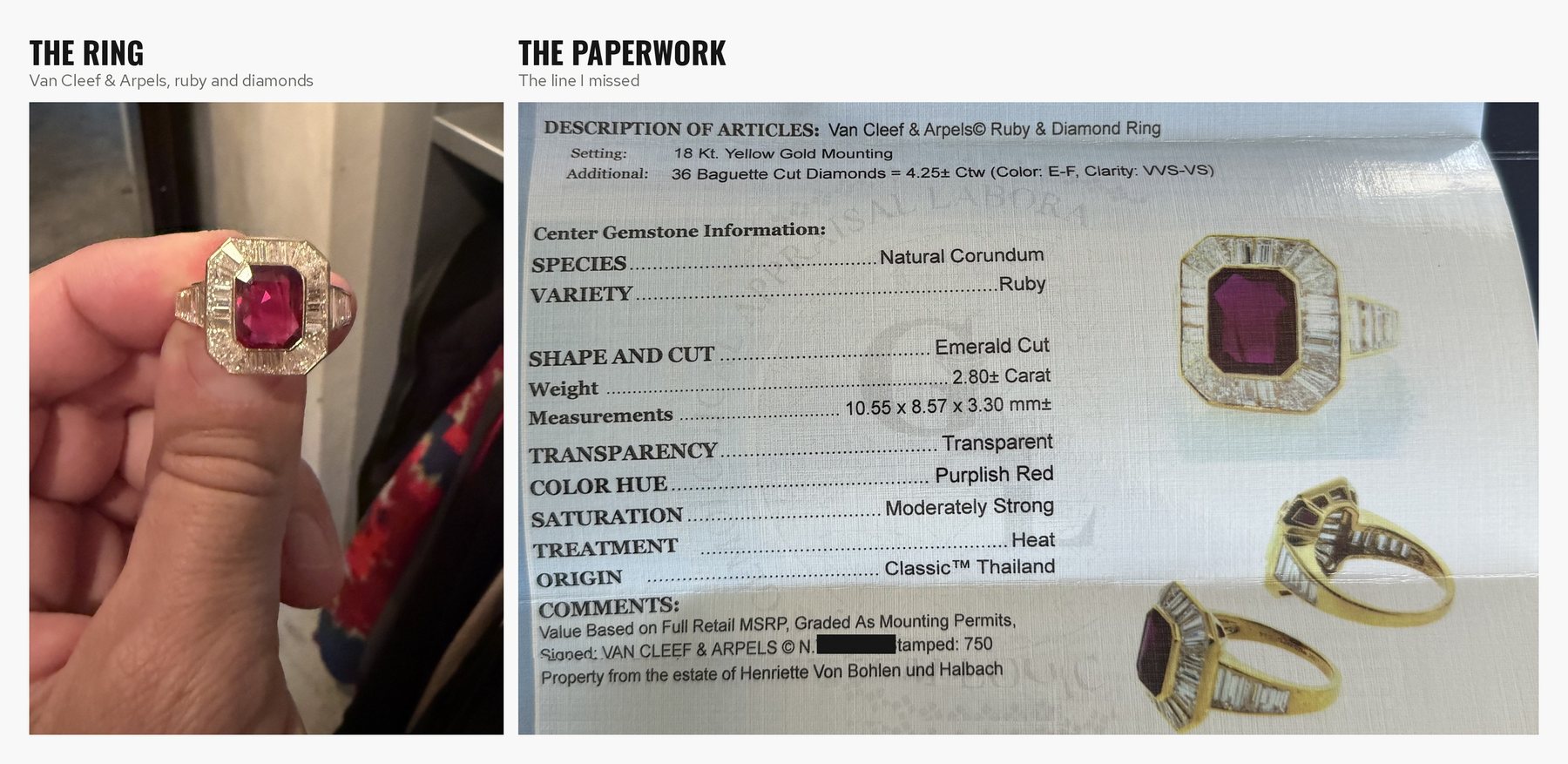
For my fortieth I bought a ring through Joseph Saidian & Sons, not from the house. If the name sounds familiar, their vintage jewelry was on Rihanna during her 2023 Super Bowl halftime show. They’d bought the ring at auction, sent me the appraisal and the paperwork, and I loved it on sight. It needed resizing, which meant Paris, which meant the Rodeo Drive flagship had to send it. So I brought it in, sat down at a desk with a Van Cleef customer experience representative, and watched them open the box.
They stopped. Gasped. Stared.
Someone called a manager. More people gathered. The guard locked the front door. This is a boutique where extraordinary jewelry is almost as commonplace as the bottled water they offer you, and suddenly the thing everyone wanted to see was my ring. Up close. From across the room. The excitement was real.
When I came back a few weeks later to collect it, the door locked again. Someone arrived with a tray of fresh juices, leaned in, and whispered: “Is that your ring in the back? I’ve never seen anything like it.”
Remember I told you I’m a part-time treasure hunter? Apparently, I’d been wearing the treasure map.
That day, Van Cleef’s manager told me my ring was a heritage piece. Turns out, the Maison has an entire Heritage Collection: original creations from the 1920s through the 1990s, sourced by the house, researched in its archives, authenticated, restored when necessary, and offered for sale again. Not reproductions. The originals, with entire lives and histories before yours.
And then the manager told me something extraordinary. If I ever considered selling my ring, I should bring it to Van Cleef first. It was exactly the kind of piece their Heritage Collection hunts for.
I’d bought the ring from Saidian, not the Maison. The reseller had supplied the official auction paperwork, but hadn’t called out the extraordinary provenance buried inside it. Van Cleef recognized a heritage piece, but the Maison doesn’t maintain the records of every third-party auction. So I did what any perfectly reasonable luxury obsessive would do. I started digging. First through Saidian’s documentation, then online.
And there it was. The estate of a European princess. Something neither the reseller nor the Maison had told me. Something I’d uncovered myself.
The reseller had the paperwork. The Maison had the eye. I connected the dots.
I have never spent a dollar at Van Cleef & Arpels. They treated me like I’d spent a million.
Three houses. Three objects bought elsewhere. The tuxedo fits me like something destined for a red carpet. Celine sent the coat home like an archival treasure. And my ring? Van Cleef made me feel like royalty. I arrived at these three luxury boutiques with items bought elsewhere, all with zero direct spend history. I left feeling as though I belonged to their story.
THAT is Brand Experience. It will never show up in an online price comparison. But I’ll remember the brands that made me feel special and part of their history.
And yet. Not one of them has invited me back.
Chapter IV
GIVE US A REASON TO WEAR THEM
The part I find exhausting is being talked at by brands as though they invented the culture we’re all living in. Here’s the community. Here’s the person you should want to be. Here’s another collaboration to prove it. But does anyone in that meeting actually know who they’re talking to?
Every feed is a storefront. Every influencer is obsessed with something they discovered approximately eleven minutes ago. Buy it now. Limited drop. Last chance. Link in bio.
And when I finally order something? Two sizes, just in case. Boxes arriving, boxes leaving, return labels, tracking numbers, refunds. My boyfriend and I sometimes look at each other and say, “This is a lot of work.”
We have more access, more information and more ways to buy than any generation before us. Somewhere along the way, shopping had all the fun sucked out of it and became a second job.
Gosh, I miss Barneys New York. Not because I can’t find the clothes. I can find almost anything. I miss the windows, the absurdity, the theater. In 2012 its Electric Holiday windows with Disney gave you something to stop for, laugh at, argue about, and bring someone back to see. A reason to leave the house. Book a table at Fred’s for brunch and spend the entire day there.
But what I miss most has a name. Barbara.
She was my personal image architect. She knew my taste, knew when to challenge it, and found me things I didn’t know I wanted. She put things aside for me before the sale hit.
The technology isn’t going away, and I don’t want it to. Pacsun and GlobalData surveyed 6,126 Americans aged 11 to 24 in June 2026. Eighty-five percent had used AI in the past year; 74 percent were open to using it for shopping discovery. Yet only 2 percent said they trusted it for fashion advice. That’s a survey, not a prediction of what every kid will do. But research and search reveal intent: someone hunting a specific piece may be telling you what they want before they ever walk into a store. They trust the machine to find better information, including price. Not to tell them who they are or what to wear.
Used AI in the past year
Americans aged 11 to 24
Open to AI for shopping
to discover what to buy
Trust it for fashion advice
to tell them what to wear
Some days I walk into Maxfield with no intention of buying anything. I want to see the edit, touch the fabric, smell the room, see what people are trying on and hear what the salespeople are excited about, and quietly note what I’ll snag if it’s still there when the sale hits. My boyfriend knows the routine so well he supplies the punchline: “Oh, you went shopping? You just wanted to feel something?”
Yes. I did.
I buy runway clothes for occasions that don’t exist yet. I invent the dinner, the city, the invitation. Sometimes it happens. Sometimes the piece waits years in my closet for a party nobody has thrown. Sometimes a purchase marks a chapter: the deal I closed, the year I survived, hitting my goal weight, or a birthday I wanted to remember.
So here I am. A closet full of grails, at my goal weight. All dressed up, nowhere to go.
Oh and news flash! The luxury brands are throwing parties. Celebrities. Influencers. Ambassadors. Creators. Some of them are wonderful collectors, of course. But you invited the people paid to wear the clothes. What about the people who paid to own them?
And this isn’t just me complaining about a guest list. BCG and Altagamma found that luxury brands fail to recognize 70 percent of their potential top-tier clients because their customer segmentation misses them. EY found that 75 percent of aspirational luxury customers would be likely to buy again from a brand offering complimentary experiences. And 73 percent would even pay for access to exclusive events.
Top-tier clients go unseen
missed by segmentation. BCG × Altagamma
Would buy again
from a brand offering complimentary experiences. EY
Would pay to get in
for access to exclusive events. EY
Different studies, different customers, same rather expensive blind spot.
We’re not asking you to give us a discount. We’re asking you to notice who already has love for your brand.
We bought your clothes, wore them, repaired them, inherited them and hunted them down on other continents. Some of us now have little businesses finding them new owners. We’ve kept falling in love with your work long after you stopped putting it in the window.
Throw us a party. Bring the artisans. Open the archive. Invite the creators, absolutely. But invite the collectors, known and unknown. The people who’ve loved your work for twenty years. The ones who know the collections better than your sales associates. The ones you haven’t met because they found their treasures somewhere else. Put the collector in the archival twenty-year-old jacket beside the twenty-year-old who can’t buy anything yet. Let someone bring her grandmother’s ring. Give us a beautiful room, music, atmosphere and a chance to marvel together at what you’ve created. Not another sales appointment with champagne. A reason to get dressed up.
Every authentic piece is part of a house’s living archive, whether it was bought yesterday, inherited, or found on a resale rack or an online platform. The collector with no transaction history may be the most knowledgeable, influential and most devoted person to walk through your door this year.
Get to know them. Ask about what they brought in. Remember them when the next invitation goes out. Notice who comes back for a repair, who brings a friend, who becomes a regular. The next purchase may follow. The relationship must start before it does.
Luxury houses can’t dictate what their pieces sell for once they leave the boutique. But when those pieces return with new owners, they can decide how to welcome them, nurture the relationship, and give those customers a reason to keep coming back.
Recently I found one of my mother’s Donna Jessica patchwork jackets listed by a vintage retailer in Japan. Plum. Burgundy. Black. A little silver star. She made it decades ago. Now a stranger on the other side of the world thinks it deserves another owner.
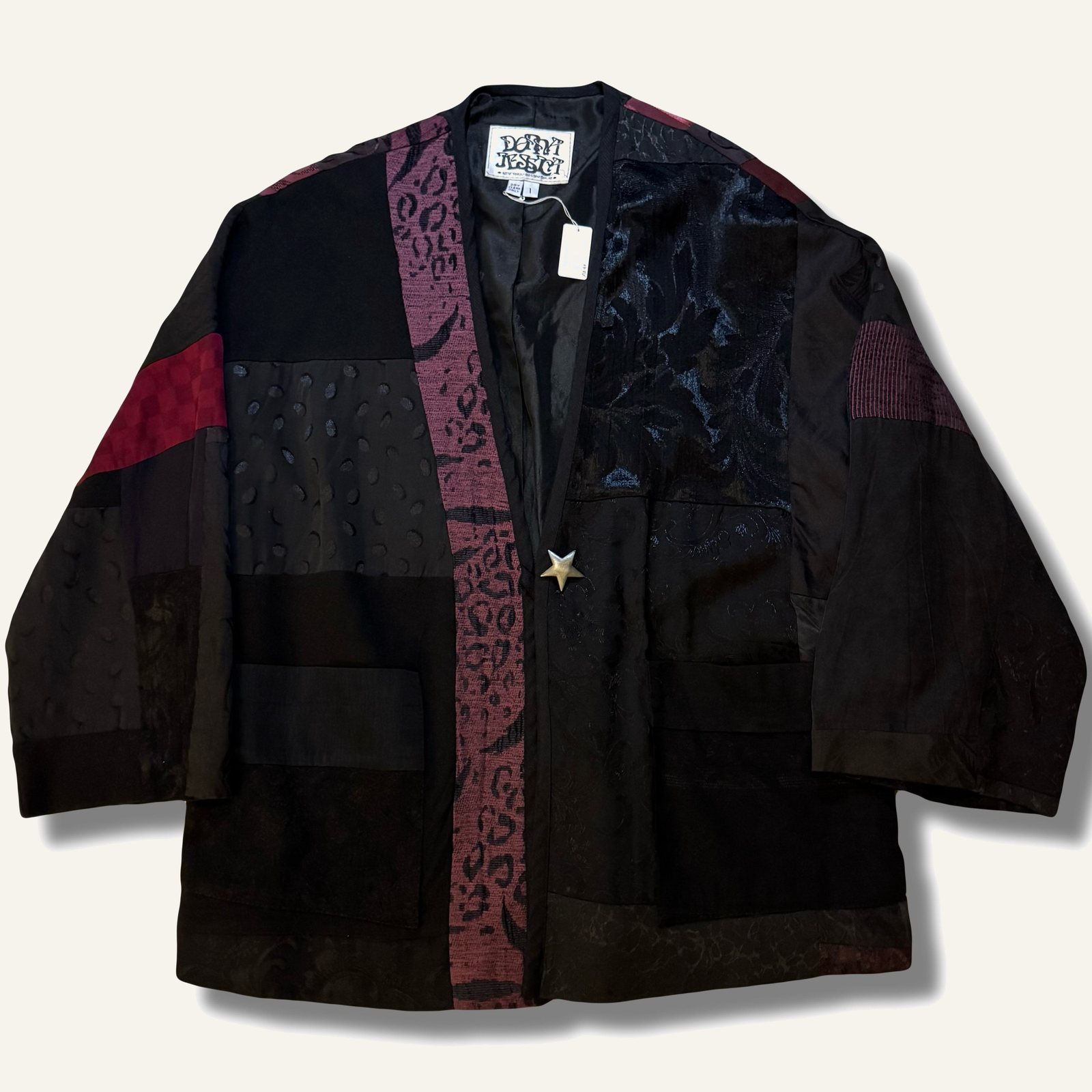
The asking price is in the hundreds again. But what got me was seeing the work there at all. My mother never had a boutique in Japan. I was looking at her fabric selection, her colors, that little star, in somebody else’s shop.
I used to cut ties open so my mother could make clothes. Decades later, I’m following those clothes around the world, watching strangers discover what she created. What I see is a global community united by a love of beautiful things. People discovering, collecting, sharing and passing them on, sometimes decades after the original sale. That love has always kept the door open for a deeper relationship with the brands that created them. Whether those brands recognize it is another story.
I think about my grandmother’s gifts. My father’s 928 when there was barely enough for the mortgage, and the Panamera he finally gave himself fifty years later. The white 911 at 34, marking one of the most significant milestones of my career. The things I’ve bought to mark getting somewhere, and the things I’ve given to people I love.
And I think about the things that will outlive me. Whoever finds them may never know how long I hunted, how ridiculous the deal was, or why I had to have them. They may know nothing about me at all.
I hope they love them anyway.
So after all the beautiful things you’ve sold us, throw us a party already. We’ve been dressed for it for years.
Maybe that’s what we’ve all been looking for. Somewhere to belong. A room full of people who understand why beautiful objects matter, and someone who remembers you when you walk through the door.
My mother knew how to create that feeling. So did Barbara. So did a whole generation of extinct brands that were way ahead of their time: Barneys. Jeffrey. Fred Segal. Places where the experience was the point and somebody on the floor knew your name.
We all miss our Barneys.
And we all miss our Barbaras.
Jason Bitensky is the Founder & CEO of YW3, a Brand Experience Studio. Culture, Realized is his quarterly read on the signals he can’t stop obsessing over.
Sources and notes
- McKinsey & Company, The State of Luxury: price increases accounted for more than 80 percent of personal luxury goods growth from 2019 to 2023.
- Bain & Company, Luxury in Transition: Securing Future Growth: about 50 million consumers left the luxury market between 2022 and 2024. Bain-Altagamma Luxury Goods Worldwide Market Monitor, spring 2026 update: seven in ten intend to return; one in two check resale before buying new.
- The RealReal, third quarter 2026 results: GMV $642 million, up 23 percent. GMV is the value of goods sold, not revenue.
- Zara × John Galliano, Re{form}, launched October 1, 2026, the first collection of a two-year partnership (Wallpaper, TheIndustry.fashion).
- Kim Kardashian in Aspen, W Magazine, January 6, 2026: Tom Ford-era Gucci leather and fur from 2003 and fall 1999. Law Roach and the Tom Ford-designed Yves Saint Laurent fall 2004 gown, worn to the Lucas Museum opening, September 19, 2026 (W Magazine). Haider Ackermann, creative director, TOM FORD.
- Kerry Taylor Auctions, The Male Sale including the personal wardrobe of Lee Alexander McQueen, London, March 10, 2026: lot 113, Gucci by Tom Ford white suit, spring 2003, worn to the 2003 CFDA Awards and on his fall 2004 runway.
- Bottega Veneta, mini Intrecciato T-shirt in Barolo, US price $10,200 (Highsnobiety). Hermès Birkin: the Baghunter study, published by a handbag reseller, claimed 14.2 percent average annual appreciation, 1980 to 2015. Sotheby’s Paris, July 10, 2025: Jane Birkin’s original Birkin sold for about $10.1 million with fees.
- Joseph Saidian & Sons, vintage jewelry on Rihanna at the 2023 Super Bowl halftime show (National Jeweler). 4Gseller, designer and vintage showroom, SoHo (press). Barneys New York × Disney, Electric Holiday windows, 2012 (The Walt Disney Company).
- Pacsun × GlobalData, The Youth Report 2026, n=6,126 Americans aged 11 to 24, surveyed June 2026: 85 percent have used AI, 74 percent are open to it for shopping discovery, 2 percent trust it for fashion advice.
- Fair Warning, New York, September 17, 2026: Naomi Campbell’s custom Alexander McQueen Plato’s Atlantis ensemble with Armadillo shoes, hammer price $1.3 million (results). Van Cleef & Arpels Heritage collection: original pieces sourced, authenticated and offered again by the house.
- EY, Luxury Client Index 2026: 75 percent of aspirational clients are likely to buy again from a brand that offers complimentary experiences; 73 percent would pay for access to exclusive events; 30 percent had received neither a complimentary experience nor an invitation to an exclusive event in the preceding 12 months. BCG × Altagamma, True-Luxury Global Consumer Insight: very important clients buy from about ten brands and are identified as such by two or three.
- Prices quoted for individual pieces are what the author saw, paid, or listed at the time. An ask is not a sale. The resale figures imagined for the Gucci coat are hypothetical. Inflation adjustments use US CPI, rounded. The author holds shares in The RealReal. Nothing here is investment advice.
- Material Possessions by Donna Jessica, annual sidewalk sale advertisement, The Allston-Brighton TAB, May 7 to 13, 1996, page 39. The clipping shown in this issue is from that page.
- Fair Warning, Naomi Campbell’s McQueen Plato’s Atlantis ensemble, $1.586 million with fees (Harper’s Bazaar).